PESO & CIMFR Certified · OISD-117 Compliant · Made in India · +91 89895 67878
Distributed siren actuation and control system — master slave multi-site network centralised dashboard, Perfect Industrial Warning Systems
Architecture
Master / Slave
Dashboard
Centralised web-based
Actuation
Remote & local
Logging
Full event log with timestamp
Health
Real-time device monitoring
Service
Annual service contract
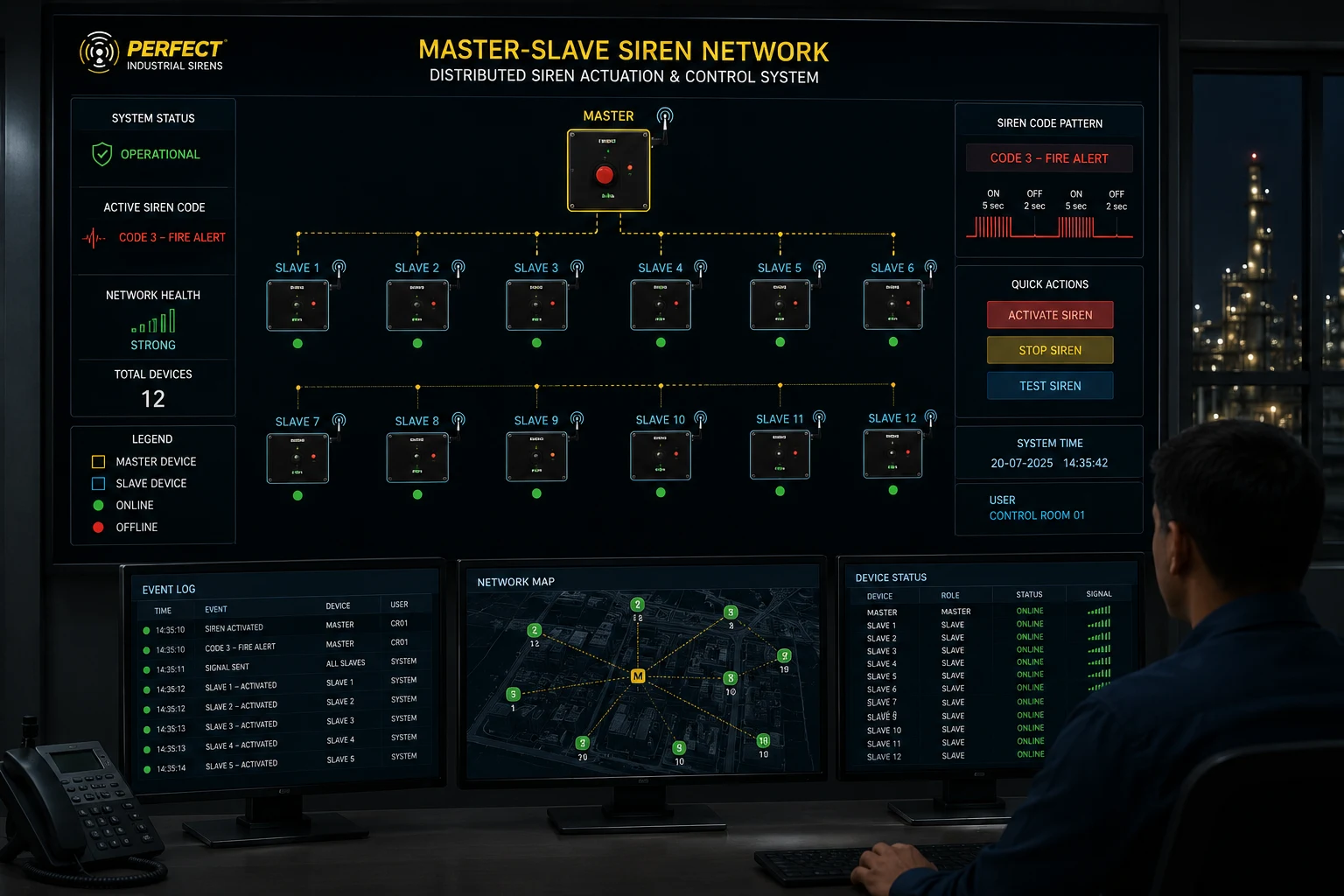
One dashboard. Every siren. Any site.

Centralised control of distributed sirens across your entire facility or group.

Large industrial facilities — refineries, steel plants, ports, mine complexes, industrial estates — cannot rely on a single siren mounted in one location. Dead zones, sound barriers, and multi-building layouts mean that one central siren leaves areas uncovered. The Distributed Siren Actuation and Control System solves this with a network of slave siren units — each placed for local coverage — all controlled from a single master panel.

The problem with single-point sirens

Why large sites need distributed systems

Coverage reality

A 5 km motor siren sounds impressive on paper. But add a row of warehouses, a road crossing, and workers in a noisy production hall wearing PPE — and the actual audible coverage drops to 1.5 km. A distributed system places sirens where the people are.

Multi-building campusesEach building zone gets its own slave siren — the master controller activates all simultaneously for plant-wide alerts, or individual zones for localised events.
OISD-117 multi-zone requirementsPetroleum refinery emergency response plans typically require independent audible alerting in each process unit, utility area, and offsite. Distributed systems meet this requirement with a single control point.
Group companies with linked sitesActivate sirens across multiple plant locations simultaneously — or selectively — from one master controller. Useful for common township/residential alerts.
Sites with previous coverage complaintsIf workers or neighbours have reported not hearing the siren, a distributed system eliminates coverage gaps without replacing the main siren.
System architecture

Master, slave, and communication

1

Master controller panel

The central panel holds the schedule, event logic, manual controls, and communication interface. Installed in the control room or security cabin.

2

Communication network

Slave units connect via RS-485 wired network (preferred for reliability) or wireless RF link (for retrofit where cabling is difficult). Each slave is addressable.

3

Slave siren units

Installed at each zone — motor siren, electronic siren, or hooter depending on coverage need. Each slave receives commands from master and activates locally.

4

Event logging and health monitoring

The master dashboard shows real-time status of every slave — active, fault, offline. All activation events are logged with timestamp for audit.

5

Manual and automatic modes

Scheduled events trigger automatically. Emergency activation from the master panel reaches all slaves simultaneously in under 2 seconds.

Buyers ask us

Distributed system questions

How many slave units can the system support?
Standard systems support 8–32 slave units. Larger configurations up to 64 slaves available for campus or township-level deployments. We size the system based on your zone map.
What happens if the master controller fails?
Each slave unit has a local manual override — allowing zone-level activation even if the master is offline. For critical sites, we recommend a hot-standby master configuration.
Can I add zones later?
Yes. The RS-485 network is expandable — add slave units without rewiring the master. Maximum cable run per segment is 1,200 metres; use repeaters for longer distances.
Do all sirens sound the same tone?
By default, all slaves mirror the master's tone command. Individual slave tone configuration is possible — for example, a fire siren in a tank farm can sound a different tone from general shift-change signals.
What is the installation requirement?
A 2-wire shielded cable (RS-485 standard) between master and each slave. Power supply to each slave unit independently from local distribution. We supply wiring diagrams, cable specifications, and commissioning support.

Need a distributed siren network?

Share your site layout, number of zones, and trigger requirements. We design the network and quote within one working day.

Also see: Motor Driven Siren → Automatic Controller → GSM Remote Siren →
📄 System architecture, network diagram & installation guide →
WhatsApp Quote